

Administrator accounts, access to production servers, connections to critical network devices... It's nothing new: these high-privilege accesses are attackers' prime target, since they open the door to an organization's entire information system.
Given this reality, the bastion host (often knows as "a PAM solution") has become an essential security building block for any organization looking to control its privileged access. But what exactly is a bastion host? How does it work? And most importantly, how do you deploy one effectively across your infrastructure?
This complete guide answers all these questions, with one goal: giving you a clear, actionable understanding of this central tool in modern cybersecurity strategy.
- What is a PAM solution ? And a bastion host ?
- Why has it become essential in cybersecurity ?
- How does PAM solution work?
- Bastion host vs. other security solutions : what are the differences ?
- Solutions and alternatives : market overview
- Concrete use cases for PAM solution
- Best practices for deploying a bastion host effectively
- Business benefits : security, compliance, and productivity
- FAQ
1. What is a PAM Solution? What is a Bastion Host?
PAM (Privileged Access Management) is the broader security discipline covering everything related to managing, controlling, and monitoring privileged accounts across an organization. A full PAM approach can include several capabilities: password vaulting, just-in-time access provisioning, multi-factor authentication, approval workflows, behavioral analytics, and session control.
What is a bastion host?
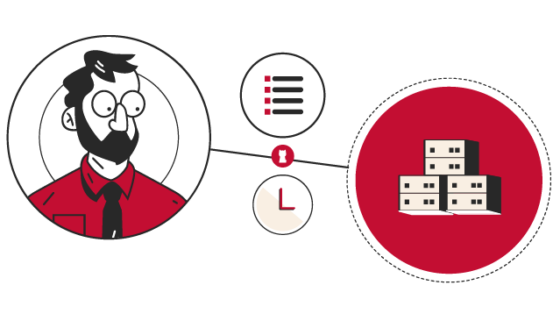
A bastion host is the core technical component that puts PAM principles into practice. It's a security system that centralizes, controls, and logs all privileged access to an information system's sensitive resources: servers, databases, network devices, critical applications, cloud environments, and more.
What is a PAM solution ?
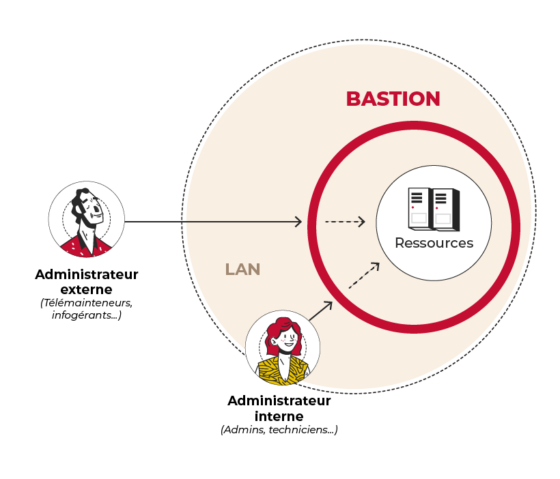
In practice, it acts as a single, mandatory gateway between privileged users (system administrators, external contractors, application maintainers) and the organization's critical resources. No administrator connection should ever go directly to a server or device. It must always pass through the bastion host.
This is why the terms "PAM" or "bastion host" are often used interchangeably in the industry : the bastion host is, in effect, the operational backbone of a PAM strategy.
The three core functions of a bastion host
- Control : Verify user identity, enforce access rights, and apply security policies (strong authentication, time-based restrictions, etc.)
- Secure : Protect and vault target resource secrets (passwords, SSH keys, certificates) without ever exposing them directly to the end user
- Trace : Log entire administration sessions (logs, metadata, and often video recordings) to enable audit and investigation in the event of an incident
2. Why has the bastion host become essential in cybersecurity?
Privileged accounts: attackers' top target
A domain administrator account grants near-unlimited access to the information system. The most common attack scenarios (ransomware, data exfiltration) almost always rely on exploiting a critical credential that is poorly protected, shared, or insufficiently monitored.
The expanding attack surface
The proliferation of environments (on-premises, cloud, hybrid), growing reliance on external contractors and managed service providers, and the rise of remote work have all multiplied and complicated sensitive access points — making manual management unworkable at scale.
Growing regulatory pressure
The NIS2 directive, applicable to a growing number of public and private entities across the EU, now mandates rigorous access management and stronger traceability of administrative actions. Frameworks such as ISO 27001, SOC 2, and national cybersecurity agency guidelines point in the same direction : controlling privileged access is no longer optional, it's a compliance requirement.
In this context, the bastion host directly supports the principle of least privilege (granting only strictly necessary rights) and the Zero Trust approach ("never trust, always verify"), two pillars of modern cybersecurity.
3. How does a bastion host work ?
The single point of passage principle
The bastion host sits between the user and the target resource. Technically, this means administrative traffic initiated by users (SSH, RDP, HTTPS) no longer reaches the target server directly: it passes through a secure jump host (the bastion) acting as an application-layer proxy.
Key mechanisms
- Password vault : Service account credentials are stored in an encrypted vault. The user never sees the actual target password — the bastion host injects it automatically when the connection is established.
- Just-in-Time (JIT) access management : Rather than granting standing privileges, the bastion host can provision temporary access, limited in duration and scope, drastically reducing the exposure window.
- Strong authentication and identity federation : Integration with corporate directories (Active Directory, LDAP), MFA (multi-factor authentication), and SSO solutions strengthens identity verification before any connection is established.
- Session recording and traceability : Every administration session is logged, timestamped, and can be recorded as video or command logs. In the event of an incident, the security team has actionable evidence for forensic investigation.
- Real-time monitoring : Some solutions enable live monitoring of active sessions, with the ability to trigger alerts or immediately terminate suspicious activity.
4. Bastion Host vs. other security solutions : what's the difference?
It's common to confuse the bastion host with other security building blocks. Here are the key distinctions:
- Firewall : Filters network traffic. The bastion host secures what happens after entry onto the network.
- VPN : Creates an encrypted network tunnel and grants network access, while the bastion host controls whether that traffic actually reaches the resources authorized by access policy.
- IAM (Identity and Access Management): A broader tool for managing all user identities and rights. The bastion host focuses specifically on high-privilege access.
- SIEM : Centralizes and analyzes security logs. The bastion host feeds the SIEM with precise, contextualized administrative logs.
The bastion host is therefore not a substitute for these tools, but an essential complement, specifically dedicated to accounts holding extensive rights over the information system.
5. Solutions and Alternatives: A Market Overview
The bastion host and PAM solutions market spans a wide spectrum, from homegrown setups to fully industrialized platforms.
Homegrown solutions and internal scripts
It can be tempting to build your own jump host system with manually configured servers, paired with password management scripts. This approach, while seemingly low-cost, comes with serious limitations: lack of granular traceability, time-consuming maintenance, and a high risk surface in case of configuration errors.
Open source solutions
Several open source projects offer building blocks for privileged access management (vaults, SSH proxies, etc.). They allow for flexible adoption with no licensing cost, but typically require :
- strong in-house expertise for integration and ongoing operations,
- assembling multiple components to cover the full scope of needs (vaulting, traceability, JIT, high availability),
- close attention to support and security updates, often maintained by a volunteer community.
These solutions suit organizations with substantial internal technical resources and a need for deep customization.
Vendor bastion host solutions
Specialized vendors offer turnkey bastion hosts that natively integrate all core functions (vaulting, time-based filters, video session recording, logging, etc.). The key selection criteria are:
- Ease of deployment and day-to-day administration : a tool that's too complex to operate ends up being bypassed by IT teams, which defeats its security purpose.
- Certification and recognition by national authorities : in France, the ANSSI CSPN security certification is a strong marker of robustness and reliability, particularly sought after by public sector organizations and operators of critical infrastructure. On the French market, PROVE IT by Rubycat is currently the only bastion host solution to hold this security certification.
- Data sovereignty : for public entities, local authorities, and critical infrastructure operators, having a solution that can be hosted on-premises and is not subject to extraterritorial legislation is an increasingly strategic criterion.
- Speed of implementation : deployment in days rather than months means an immediate reduction in exposure.
The choice between an open source and a vendor solution depends primarily on your internal resources, your compliance requirements, and the time you can dedicate to maintaining the tool. For a small or mid-sized organization without a dedicated PAM security team, a packaged, certified, and easy-to-administer solution is generally the most sensible choice.

6. Real-world use cases for bastion hosts
Securing external contractor access (managed services, outsourced IT)
A bastion host allows a contractor to be granted temporary access, limited to the strictly necessary scope, without ever sharing the real credentials of the administered servers.
Governing internal IT teams
Even internally, sharing a generic admin account across multiple technicians is a high-risk practice. The bastion host allows each connection to be individualized, ensuring accountability for every action.
Regulatory compliance and audit readiness
For organizations subject to NIS2, ISO 27001, or sector-specific requirements (healthcare, finance, public sector), the bastion host automatically provides the traceability evidence required during audits : who connected, to which resource, and when.
Incident response and forensic investigation
In the event of an incident, bastion host session recordings allow precise reconstruction of the timeline of actions taken by a sensitive account, considerably speeding up the investigation.
Cloud and hybrid environments
In a cloud or hybrid environment, the bastion host centralizes administrator access across the entire scope (on-premises and cloud), avoiding the need for multiple security tools and methods.
7. Best practices for deploying a bastion host effectively
- Map existing privileged accounts and access points : Before any deployment, conduct a thorough inventory: administrator accounts, service accounts, contractor access, and technical application accounts.
- Prioritize the most critical resources : A phased rollout — starting, for example, with the highest-risk population or the most sensitive servers and applications — delivers quick wins and eases team adoption.
- Involve IT teams from the design phase : Administrator buy-in is a key success factor: a bastion host perceived as an excessive constraint will be bypassed. Choose a solution whose usability doesn't hinder daily productivity.
- Pair the bastion host with multi-factor authentication (MFA) : it's the ideal control point for enforcing systematic strong authentication before any access to a sensitive resource.
- Define a Just-in-Time access policy : Minimize the lifespan of granted privileged access as much as possible, particularly for high-risk accounts (domain accounts, root accounts).
- Regularly audit logs and recorded sessions : Traceability data only has value if it's actually used — set up a periodic review of access rights and at-risk sessions.
Deploying a bastion host isn't just about installing a tool: it involves rethinking access architecture, mapping existing privileged accounts, and integrating the solution into an often-complex existing IT environment. To secure this critical phase and avoid configuration errors that could introduce new vulnerabilities, we recommend working with your usual integrator or a specialized cybersecurity and PAM integrator.
8. Business benefits : security, compliance, and productivity
In summary, bastion hosts deliver a wide range of business benefits :
- Reduced cyber risk : Drastic reduction of the attack surface tied to privileged accounts — the primary vector for major cyberattacks
- Regulatory compliance : Direct response to NIS2, ISO 27001, and national cybersecurity agency recommendations on traceability and access control
- Auditability : Evidence readily available for internal or external audits, without tedious manual reconstruction
Control over external contractors: Granular, revocable control of access granted to outsourced IT providers or any third party - Time savings for IT teams : Centralized credential management, eliminating manual password rotation procedures
- Peace of mind in the event of an incident : The ability to quickly identify the origin and scope of a compromise thanks to session recordings
Conclusion
The bastion host has become an indispensable pillar of any serious cybersecurity strategy, particularly for organizations subject to strengthened compliance requirements (NIS2, ISO 27001...). By centralizing, securing, and tracing all privileged access, it considerably reduces exposure to cyberattacks while simplifying compliance demonstration during audits.
What remains is choosing the solution best suited to your context : available internal resources, certification requirements, data sovereignty needs, and desired speed of implementation are all criteria to weigh before getting started.

Discover PROVE IT bastion host
With PROVE IT, you can easily secure, control and trace your privileged access.
FAQ
What is a bastion host in a few words ?
A bastion host (or PAM bastion) is a security solution that centralizes, controls, and records all access to an organization's sensitive systems (servers, databases, and network devices).
It acts as a mandatory gateway between administrators and critical resources : every connection is authenticated, logged, and can be recorded as video sessions or detailed logs. This approach, known as PAM (Privileged Access Management), makes it possible to enforce the least-privilege principle and provide audit evidence in the event of an incident or regulatory review.
What's the difference between a PAM solution and a bastion host ?
PAM (Privileged Access Management) is a broad category that can include several capabilities : password vaulting, just-in-time access, multi-factor authentication, approval workflows, behavioral analytics, and session control.
A bastion host is the core technical component of a PAM strategy. It acts as the mandatory gateway through which all privileged sessions pass, enabling authentication, traceability, and session recording. In other words, every bastion host is part of a PAM approach, but not every PAM capability requires a full, all-in-one PAM suite.
Many organizations choose a dedicated bastion host to cover their most critical need (controlling and auditing privileged access) without the complexity of deploying a complete PAM platform.
Is a bastion host legally required ?
No regulation explicitly mandates the use of a "bastion host." However, the traceability and privileged access control requirements set out in frameworks such as NIS2, ISO 27001, or sector-specific standards make its deployment strongly recommended and in practice, often essential to meet these obligations.
What's the difference between a bastion host and a traditional jump server ?
A jump server only provides network relay functionality, without necessarily including a password vault, granular access rights management, or advanced traceability. A PAM bastion host covers these functions and goes well beyond them.
Is deploying a bastion host complex ?
This largely depends on the solution chosen. In-house or open-source architectures require significant integration effort. Vendor solutions designed for ease of deployment can be up and running in just a few days.
Does a bastion host slow down administrators' work ?
A well-designed and properly configured bastion host should not degrade the user experience. The goal is to secure access without adding excessive friction (friction that could otherwise push IT teams to bypass the tool altogether).
Written by

Other posts

Passkeys : A new era for strong authentication
Publish on June 03, 2025

Active Directory : Microsoft's Complete Directory
Publish on October 28, 2024

Strengthen connection security with WebAuthn : Its Integration in our PROVE IT PAM solution
Publish on August 16, 2024