
- What is the Principle of Least Privilege (PoLP)?
- Why is the principle of least privilege important?
- How to apply the principle of least privilege?
- How does Rubycat's PROVE IT PAM – Administration Bastion solution facilitate the application of the principle of least privilege?
Cybersecurity has become one of the major concerns of all organizations, from technology giants to SMEs.
Online threats are omnipresent, sophisticated, and potentially devastating. In this constantly evolving digital landscape, the principle of least privilege (or principle of least privilege – PoLP in English) has established itself as one of the fundamental pillars of IT security. In this article, we will study this essential concept, understand its ins and outs, and discover how it can help protect our data and information systems.
What is the Principle of Least Privilege (PoLP)?
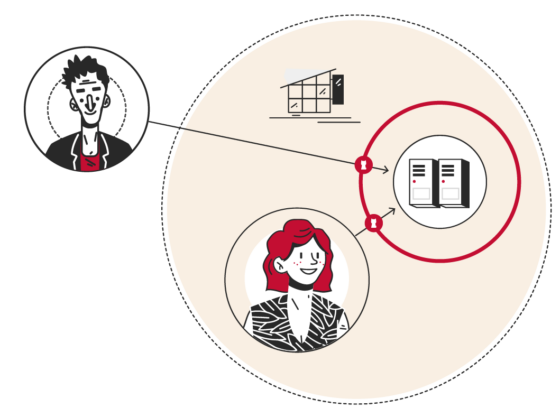
The principle of least privilege is a philosophy of managing access rights in the field of IT security. It is based on a simple but powerful concept: a user should have the minimum level of access required to accomplish their specific task, no more and no less. In other words, instead of granting broad permissions to a user or program, the idea is to limit their permissions to what is strictly necessary, a key concept for managing and protecting privileged access.
This means that if a user does not need to access certain data or features to perform their work, they should not have the ability to do so. This significantly limits risks related to potential abuse, human error, and cyberattacks.
In practice, in companies or public organizations, this is generally implemented through Role-Based Access Control (RBAC). Each access decision is based on the role to which the user or privileged account is associated.
Why is the principle of least privilege important?
The principle of least privilege or least privilege is essential for several reasons :
1. Risk reduction
The first advantage of the principle of least privilege is the significant reduction of risks. By strictly limiting access rights, this approach minimizes the potential attack surface. Even if a user account is compromised by a malicious actor, access is restricted to only the resources necessary to accomplish that user's specific task. Thus, the attacker cannot access sensitive data or systems that are not relevant to their role, which significantly limits potential damage.
Example: a marketing department employee does not need to access the company's financial databases. By applying the principle of least privilege, this employee only has the authorizations necessary to perform their marketing tasks, thus eliminating the possibility of unauthorized access to sensitive financial data.
2. Prevention of human error
Human errors are a reality in all fields, including IT security. However, least privilege helps minimize the risks associated with these errors. By limiting the scope of authorizations granted to each user, the possibilities of serious errors are reduced.
Imagine a scenario where an employee, having accidentally access to sensitive data, deletes or alters it. With the principle of least privilege, such errors would be prevented, because the user would not have had the permissions to perform such actions.
3. Protection of confidentiality
The protection of data confidentiality is a major concern for many organizations, particularly those that process sensitive information such as customer personal data. The principle of least privilege plays an essential role in preserving this confidentiality. By restricting access to only authorized individuals, it prevents accidental or malicious data leaks.
In a healthcare company that stores medical records, doctors and nurses must have access to these records, but administrative staff members do not need this type of authorization. By applying this principle, only qualified medical users have access to this confidential data.
4. Regulatory compliance
In an increasingly strict regulatory landscape, the principle of least privilege is often required to comply with data protection regulations. The European Union's General Data Protection Regulation (GDPR) requires companies to limit access to personal data to what is strictly necessary for each task. By following this principle, organizations can avoid financial penalties and preserve their reputation.
5. Simplified user management
By assigning permissions based on roles and responsibilities, the principle of least privilege significantly simplifies user management (particularly privileged accounts) and their access rights. Administrators can easily track who has access to what, what authorizations are necessary for each position, and what changes are needed if a role changes. Dynamic management of privileged access (or Privileged Access Management – PAM) and the implementation of administration bastions for privileged accounts!
How to apply the principle of least privilege?
Applying the principle of least privilege is an essential step in creating a more secure IT environment. However, its implementation can vary depending on the needs and specificities of each organization. Here is an overview of the key steps to successfully deploy this principle in your IT infrastructure.
1. Assessment of needs
The first step toward successful implementation is a careful assessment of the needs of each user or group of users within your organization. This assessment must answer crucial questions such as:
- What are their responsibilities? Understand in detail the specific functions and tasks they are supposed to accomplish.
- Privileged accounts vs. standard accounts, list in detail the different types of privileged access...
- What data or features do they need to accomplish their tasks? Identify the IT resources, applications, and data they should be able to access.
This assessment allows you to precisely define the authorizations necessary for each user or group of users, avoiding granting them excessive and unjustified access to sensitive or critical resources.
2. Assignment of roles and responsibilities
Once needs have been identified, it is time to create roles and user groups based on those needs. This step is important to ensure efficient management of permissions and privileges. Each role is assigned specific permissions based on the responsibilities associated with that role: user, administrator, auditor, consultant, remote maintainer…
3. Implementation of identity and access management (IAM) and Privileged Account Management (PAM)
The implementation of Identity and Access Management (IAM) and Privileged Access Management (PAM) is a fundamental step to effectively ensure compliance with the principle of least privilege. These solutions are designed to automate and streamline the process of granting and revoking permissions, ensuring that each user (standard or privileged) has only the access rights indispensable for accomplishing their tasks.
These solutions also offer the ability to comprehensively monitor and audit the activities of users, administrators, and third parties (consultants, auditors, remote maintainers). This proves essential for quickly identifying potentially suspicious activities and maintaining a high level of security within the organization.
By integrating these two solutions, IAM and PAM, a company creates an environment where access rights are rigorously managed, monitored, and adjusted in real-time based on users' changing needs. This reduces security risks, minimizes human errors, and ensures that only authorized employees have access to the company's sensitive resources, which is essential for robust IT security.
Finally, if you are still in doubt about the importance of implementing privileged account management, you can consult the 10 reasons to install a PAM solution - PROVE IT.
4. Regular reviews and updates
The needs of users and groups evolve over time. Changes in positions, promotions, employee departures are all factors that can influence authorization needs. Therefore, it is essential to regularly review permissions and adjust them accordingly.
This means that review and update processes must be regular and well documented. IT security teams must work closely with department managers to ensure that access rights remain aligned with actual needs.
How Rubycat's PROVE IT PAM solution facilitates the application of the principle of least privilege
The PROVE IT software solution contributes to the application of the principle of least privilege in several ways:
Strict access control: PROVE IT allows you to manage sensitive access to your IS equipment in a granular manner. You can define specific permissions based on the roles and responsibilities of each privileged user. This means that each user obtains only the privileges necessary to accomplish their tasks, in accordance with the principle of least privilege.
Risk reduction: By limiting access to critical resources, the PROVE IT IT bastion significantly reduces the risks of abuse, hacking, or exploitation of data and systems. Users only have the necessary access, which limits the potential attack surface.
Traceability and auditability: All activities performed via PROVE IT are systematically recorded. This allows complete traceability of actions, which is essential for auditing and rapid detection of suspicious activities. You can quickly identify any violation of the principle of least privilege.
Credential management: The PROVE IT cyber bastion integrates centralized credential and secret management functionalities (secure secondary credential vault). This strengthens the security of privileged accounts, as access to sensitive credentials is restricted, in accordance with the principle of least privilege.
Privileged Access Management (IT PAM) addresses a specific limitation of the principle of least privilege, namely that we will always need roles that have many, if not all, privileges (CIO, CISO, administrators, auditors...). The implementation of PAM and Rubycat's PROVE IT administration bastion makes it possible to add an essential layer of security by more strictly controlling and tracking what these privileged users do on the IS.
Conclusion
The principle of least privilege is far more than a simple IT security concept; it is an essential foundation of modern cybersecurity. By limiting access rights to strictly necessary levels, organizations can significantly reduce risks, protect data confidentiality, and remain compliant with regulations.
Discover PROVE IT and all its features
Other posts

PAM solution & bastion host : the essential safeguard for securing your privileged access
Publish on November 26, 2025

Passkeys : A new era for strong authentication
Publish on June 03, 2025

Active Directory : Microsoft's Complete Directory
Publish on October 28, 2024