
In the world of cybersecurity, the term "SSH Bastion" is often searched for, but remains poorly understood. As enterprises constantly seek to strengthen their information systems (IS), understanding the true role and effectiveness of an SSH bastion host is essential. This article aims to demystify the concept and explore more advanced solutions like PROVE IT by Rubycat.
What is an SSH Bastion host ?
The SSH bastion is a critical component of cybersecurity, acting as a secure control point for remote access to an internal network, typically via command line. Imagine a bastion server as a vigilant guard at the entrance of a fortress: it scrutinizes each individual who wishes to enter and ensures they have the right to pass. This dedicated and secured server is the only point through which SSH (Secure Shell) connections are authorized, guaranteeing centralized control and enhanced security.
The most well-known key functions of the bastion host server :
- Single entry point : It centralizes all SSH connections, offering simpler access control.
- Enhanced security : Thanks to the SSH protocol, communications are encrypted, ensuring data confidentiality and integrity.
- Advanced authentication : Uses diverse authentication methods such as SSH keys, multi-factor authentication, or digital certificates.
- Logging and audit : All SSH sessions are recorded, facilitating security audits and incident analysis.
- Filtering and access control : Strict rules are applied to define who can connect and which systems they can access.
By deploying an SSH bastion, an organization creates a solid barrier against cyber threats. This bastion server does not merely filter traffic; it plays an active role in network defense. Its configuration and management require special attention : it must be regularly updated, continuously monitored, and isolated from other systems to reduce the attack surface.
In summary, the SSH bastion host is considered a combination of rigorous security strategy and advanced technology. It serves not only as a control point for network access but also as an essential tool for monitoring, auditing, and managing security risks. When properly configured, it becomes a cornerstone of an organization's cybersecurity strategy. However, this system can hide significant disparities.
The SSH jump server method
SSH jump servers, also known as "bastion hosts" or "jump hosts," are servers configured to act as secure gateways to other machines located in private networks. They are often used in enterprise network environments where direct access to internal servers is restricted for security reasons.
How an SSH jump server generally works:
- Initial access: The user first connects to the jump server via SSH. This server is usually located in the public network or in a less sensitive security perimeter zone.
- Authentication: Once connected to the jump server, the user must typically authenticate using their credentials (username and password, or SSH keys).
- Access to internal resources: Once authenticated on the jump server, the user can use additional SSH commands to connect to internal servers in the private network. These connections may be direct or via other intermediate servers depending on the network topology.
SSH jump servers offer several security advantages:
- Reduction of entry points: By limiting direct access to internal servers, jump servers reduce the potential attack surface of the network.
- Tracking and audit: All connections to internal servers pass through the jump server, facilitating tracking and auditing of user activities.
- Access control: Firewall rules and security policies can be more easily applied on the jump server to control who can access internal resources.
- Centralized authentication: Users can be authenticated centrally on the jump server, simplifying user account management.
SSH jump servers are an important component of network security architectures, offering a safe and controlled way to access internal resources from unsecured external networks.
The limitations of SSH jump servers
SSH jump servers, while useful for security and access management, have significant limitations. This is where PROVE IT by Rubycat comes in to fill these gaps:
- Configuration complexity : Jump servers can be difficult to configure and manage, especially in complex network environments. In contrast, PROVE IT is designed to be easy to configure, even in the most demanding environments.
- Deployment and maintenance : Setting up and maintaining a jump server can require additional resources, increasing network infrastructure costs. With PROVE IT, these costs are reduced through simplified management.
- Visibility and control of user actions : Traditional jump servers may not offer complete visibility into user actions or sufficient control. PROVE IT, on the other hand, provides complete visibility and precise control of user actions, thus improving security and compliance.
It is important to note that certain limitations inherent to jump servers, such as single point of failure, server overload, increased latency, poor fault tolerance, and dependency on Internet connections, may also exist with other bastion solutions.
However, the ease of configuration, simplified management, and enhanced user action control offered by PROVE IT make it a superior solution for securing access to internal resources. In summary, PROVE IT by Rubycat offers a simpler and more manageable solution for securing access to internal resources, while addressing the same security challenges as traditional jump servers.
PROVE IT : An advanced approach to SSH bastion host
Unlike homegrown solutions, PROVE IT by Rubycat offers a more sophisticated and secure approach to the bastion concept. PROVE IT integrates:
- Enhanced traceability : Precise tracking of user actions from the moment they connect to the bastion, ensuring better auditability.
- Access restrictions : Access rights are strictly controlled, limiting users to only necessary resources.
- Customizable access policies : Detailed access policies, ensuring that only authorized users can access specific resources.
- Fast to deploy (easy integration into the IS – 30 mins) and 3 hours for tool proficiency
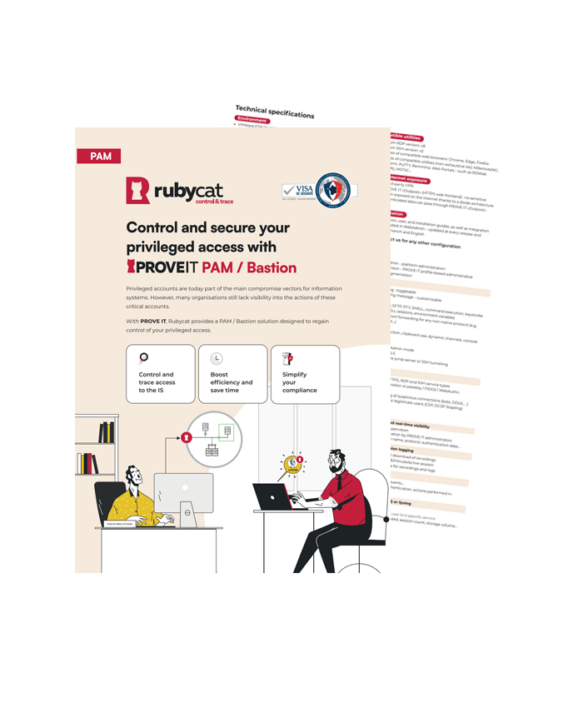
Consult PROVE IT Documentation
Our solutionTo learn more about the features of our bastion solution, discover our datasheet.
Practical application of PROVE IT
Let's illustrate with a concrete example: a hospital group uses PROVE IT to manage access to its critical servers containing sensitive data.
- Before PROVE IT implementation : Employees used an in-house SSH bastion host, which resulted in traceability issues and security risks (not to mention user friction...).
- With PROVE IT : The organization was able not only to monitor and record all SSH sessions but also to enforce strict access policies, thereby ensuring enhanced security and regulatory compliance.
Conclusion
By understanding the limitations of traditional SSH bastion models and adopting advanced solutions like PROVE IT, companies can effectively strengthen their security. PROVE IT by Rubycat is not just an SSH bastion ; it is a comprehensive privileged access management solution, designed to meet modern cybersecurity challenges.

Discover our bastion host
ContactExplore how PROVE IT controls and traces all your privileged access.
Other posts

PAM solution & bastion host : the essential safeguard for securing your privileged access
Publish on November 26, 2025

Passkeys : A new era for strong authentication
Publish on June 03, 2025

Active Directory : Microsoft's Complete Directory
Publish on October 28, 2024